Celestial Offerings and Ancient Echoes: The Tenggerese Journey Through Time at Mount Bromo
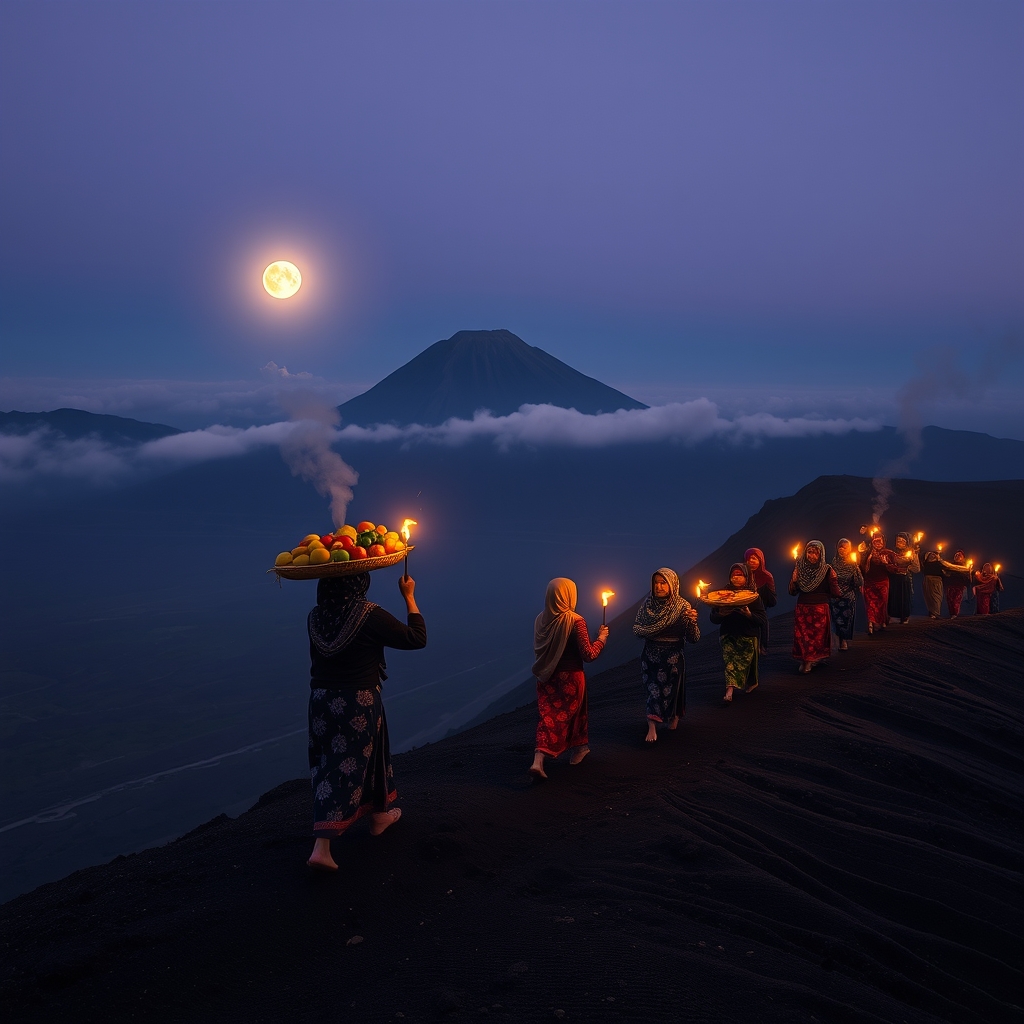
High in the mist-shrouded highlands of East Java, where the earth trembles beneath the weight of ancient legends and the air hums with the whispers of the past, the Tenggerese people have carved a life of harmony between the sacred and the sublime. Their story is not merely one of survival amidst the raw power of Mount Bromo, but a testament to the enduring spirit of a culture that has turned the volatile heart of a volcano into a cradle of devotion. Here, in the shadow of one of Indonesia’s most iconic natural wonders, the Tenggerese have woven a tapestry of rituals, myths, and traditions that continue to captivate the world.
The Origins: A Love Forged in Fire and Ash
The origins of the Tenggerese people are as dramatic as the landscape they call home. According to Tenggerese Hindu history, their lineage traces back to the legendary figures of Roro Anteng and Joko Seger, a princess and a commoner whose love story transcended the boundaries of mortal life. The Legend of Roro Anteng tells of a promise made to the gods—a vow to sacrifice their youngest child in exchange for the prosperity of their people. When the time came to fulfill this vow, the couple’s grief was so profound that the gods took pity on them, demanding instead an annual offering of crops, livestock, and prayers. This act of devotion laid the foundation for the Yadnya Kasada Festival, a ritual that has endured for centuries.
The Joko Seger mythology further enriches this narrative, portraying him as a figure of resilience and wisdom. Together, Roro Anteng and Joko Seger are revered as the progenitors of the Tenggerese, their legacy etched into the very soil of the Tengger Highlands. Their story is not just a myth; it is a living part of the culture, a reminder of the sacrifices that bind the Tenggerese to their land and their gods.
The Sacred Heart: Luhur Poten and the Tenggerese Faith
At the spiritual core of the Tenggerese community lies Luhur Poten Temple, a sanctuary perched on the edge of Mount Bromo’s caldera. Unlike the grand, ornate temples of Bali, Luhur Poten is a humble yet profound structure, built from black volcanic stone that mirrors the rugged terrain surrounding it. Here, the Tenggerese gather to honor their deities, seeking blessings for harvests, protection from natural disasters, and guidance in their daily lives. The temple is not just a place of worship; it is a bridge between the earthly realm and the divine, a space where the sacred and the mundane intertwine.
The Tenggerese faith is a unique blend of Hinduism and animism, a syncretic tradition that predates the arrival of Islam and modern Hinduism in Java. Their rituals are led by Tenggerese priests, known as Dukun, who act as intermediaries between the people and the spirits of the mountain. These priests undergo years of training, mastering the ancient chants, offerings, and ceremonies that define Tenggerese spirituality. Their role is not merely ceremonial; they are the keepers of wisdom, the guardians of a cultural heritage that has withstood the test of time.
The Yadnya Kasada: A Festival of Devotion and Renewal
Every year, as the full moon rises over the Tengger Highlands, the Tenggerese people gather for the Yadnya Kasada Festival, one of the most spectacular cultural events in Indonesia. The festival, which typically falls in the 12th month of the Tenggerese calendar (around July or August), is a vibrant display of faith, gratitude, and communal unity. Pilgrims from across the region ascend the slopes of Mount Bromo, carrying offerings of rice, fruits, vegetables, livestock, and even money, which they toss into the volcano’s crater as a tribute to the gods.
The origins of the Kasada Festival date back to the legend of Roro Anteng and Joko Seger, but its significance has evolved over time. Today, it is not only a religious observance but also a celebration of the Tenggerese identity. The festival attracts thousands of visitors, both local and international, who come to witness the breathtaking sight of devotees climbing the steep slopes of the volcano, their figures illuminated by the glow of torches against the night sky. For the Tenggerese, the Yadnya Kasada is a moment of renewal—a chance to reaffirm their bond with the land and their ancestors.
Rituals of the Earth: The Tenggerese Way of Life
The Tenggerese way of life is deeply intertwined with the rhythms of nature. Their Tenggerese traditional rituals are not confined to the Yadnya Kasada; they are woven into the fabric of daily existence. From the planting of crops to the harvesting of fields, every act is accompanied by prayers and offerings, a testament to their reverence for the earth. The Tenggerese believe that Mount Bromo is not just a physical entity but a living, breathing force—a Mount Bromo sacred mountain that demands respect and gratitude.
One of the most poignant rituals is the offering ceremony at Bromo, where families gather to present their harvest to the gods. These ceremonies are often led by the Dukun, who recite ancient mantras and perform sacred dances to invoke blessings. The offerings, known as sesajen, are meticulously prepared, with each item symbolizing a different aspect of life—prosperity, health, protection, and harmony. The rituals are a reminder that for the Tenggerese, spirituality is not separate from the natural world; it is an integral part of it.
The Resilience of a Culture: Surviving Eruptions and Change
The history of the Tenggerese is marked by resilience. Living in the shadow of an active volcano means confronting the ever-present threat of historical Mount Bromo eruptions. Over the centuries, the Tenggerese have witnessed the raw power of the mountain, its eruptions reshaping the landscape and testing the limits of their endurance. Yet, time and again, they have rebuilt their lives, their faith unshaken. The 2010 eruption, which blanketed the region in ash and disrupted daily life, was a stark reminder of nature’s unpredictability. But for the Tenggerese, such events are not merely disasters; they are part of a cycle, a dialogue between the earth and its people.
Despite the challenges posed by modernity, the Tenggerese have managed to preserve their indigenous Tengger culture. While younger generations may leave the highlands in search of education and opportunity, many return, drawn by the pull of their heritage. The Tenggerese language, a dialect of Javanese, is still spoken in the villages, and traditional clothing, music, and dance continue to be passed down through the generations. The culture is not static; it evolves, adapting to the changing world while holding fast to its roots.
Mount Bromo: A Beacon of Cultural Tourism
In recent years, Mount Bromo has emerged as one of Indonesia’s premier destinations for Bromo cultural tourism. Visitors flock to the region not only for its breathtaking landscapes but also for the chance to immerse themselves in the rich tapestry of Tenggerese culture. The Yadnya Kasada Festival, in particular, has become a major draw, offering a rare glimpse into the spiritual life of the Tenggerese. Tourists are often struck by the warmth and hospitality of the local people, who welcome outsiders with open arms, eager to share their stories and traditions.
However, the rise of tourism has also brought challenges. The influx of visitors has put pressure on the delicate ecosystem of the Tengger Highlands, and there are concerns about the commercialization of sacred rituals. The Tenggerese community is acutely aware of these issues, and many are working to strike a balance between preserving their cultural heritage and embracing the opportunities that tourism brings. Initiatives such as community-based tourism and eco-friendly practices are helping to ensure that the magic of Mount Bromo endures for generations to come.
The story of the Tenggerese is one of harmony—between people and nature, between the past and the present, between the sacred and the everyday. Their rituals, myths, and traditions are not relics of a bygone era but living, breathing expressions of a culture that continues to thrive in the heart of one of the world’s most awe-inspiring landscapes. As the sun rises over the caldera of Mount Bromo, casting its golden light on the ancient temples and the faces of the Tenggerese people, it is impossible not to feel the weight of history and the promise of the future. Here, where the earth still whispers the names of gods and ancestors, the spirit of the Tenggerese endures, as timeless and unyielding as the mountain itself.