Mystical Flames and Ancient Vows: The Tenggerese Legacy and the Sacred Rituals of Mount Bromo
The mist-shrouded highlands of East Java cradle one of Indonesia’s most enigmatic cultures—the Tenggerese people. Nestled in the shadow of the towering Mount Bromo, this indigenous community has preserved a way of life that intertwines deep spiritual devotion with the raw, untamed power of nature. Their story is one of resilience, myth, and an unbreakable bond with the sacred volcano that dominates their landscape. At the heart of this bond lies the Yadnya Kasada Festival, a centuries-old ritual that embodies the Tenggerese’s reverence for their ancestors and the forces that shape their world.
The Origins of the Tenggerese: A Legacy Forged in Myth
The history of the Tenggerese people is steeped in legend, with roots that trace back to the Majapahit Empire, one of the greatest kingdoms in Indonesian history. According to folklore, the Tenggerese are the descendants of Roro Anteng, a princess of the Majapahit royal lineage, and her husband, Joko Seger. Their love story is one of both romance and tragedy, set against the backdrop of a kingdom in decline. As the Majapahit Empire crumbled, Roro Anteng and Joko Seger fled to the safety of the highlands, where they established a new community. The name “Tengger” itself is derived from the last syllables of their names—Anteng and Seger—symbolizing their enduring legacy.
The couple’s story is not merely a tale of survival but a foundation myth that explains the origins of the Tenggerese people. It is said that the gods, moved by their devotion, granted them 25 children but demanded the sacrifice of their youngest, Raden Kusuma, to ensure the prosperity of their descendants. This tragic offering is believed to have sanctified the land, binding the Tenggerese to Mount Bromo in a sacred covenant that continues to this day.
The Sacred Heart of Tenggerese Spirituality: Luhur Poten Temple
At the spiritual core of the Tenggerese community lies the Luhur Poten Temple, a modest yet profoundly significant structure perched on the edge of the Bromo caldera. Unlike the grand temples of Bali or Java, Luhur Poten is a humble sanctuary, constructed from volcanic stone and adorned with offerings of flowers, incense, and woven fabrics. It serves as the focal point for the Tenggerese’s religious ceremonies, where priests known as dukun or resi lead rituals that honor the gods and ancestors.
The temple’s location is no coincidence. It sits at the foot of Mount Bromo, a volcano that the Tenggerese regard as a sacred entity, a living manifestation of divine power. The mountain is not merely a geological feature but a spiritual beacon, a place where the earthly and the divine intersect. The Tenggerese believe that Bromo’s eruptions are expressions of the gods’ will, a reminder of the delicate balance between human life and the forces of nature. This belief is reflected in their rituals, which seek to appease the spirits and maintain harmony with the land.
The Role of the Dukun: Guardians of Tradition
The dukun, or traditional priests, are the keepers of the Tenggerese’s spiritual heritage. They are not only religious leaders but also healers, mediators, and custodians of ancient knowledge. The dukun undergo rigorous training, often inheriting their roles from previous generations, and are responsible for conducting rituals, interpreting omens, and guiding the community through life’s challenges. Their authority is derived from their deep understanding of the Tenggerese’s oral traditions, which include chants, prayers, and sacred texts passed down through centuries.
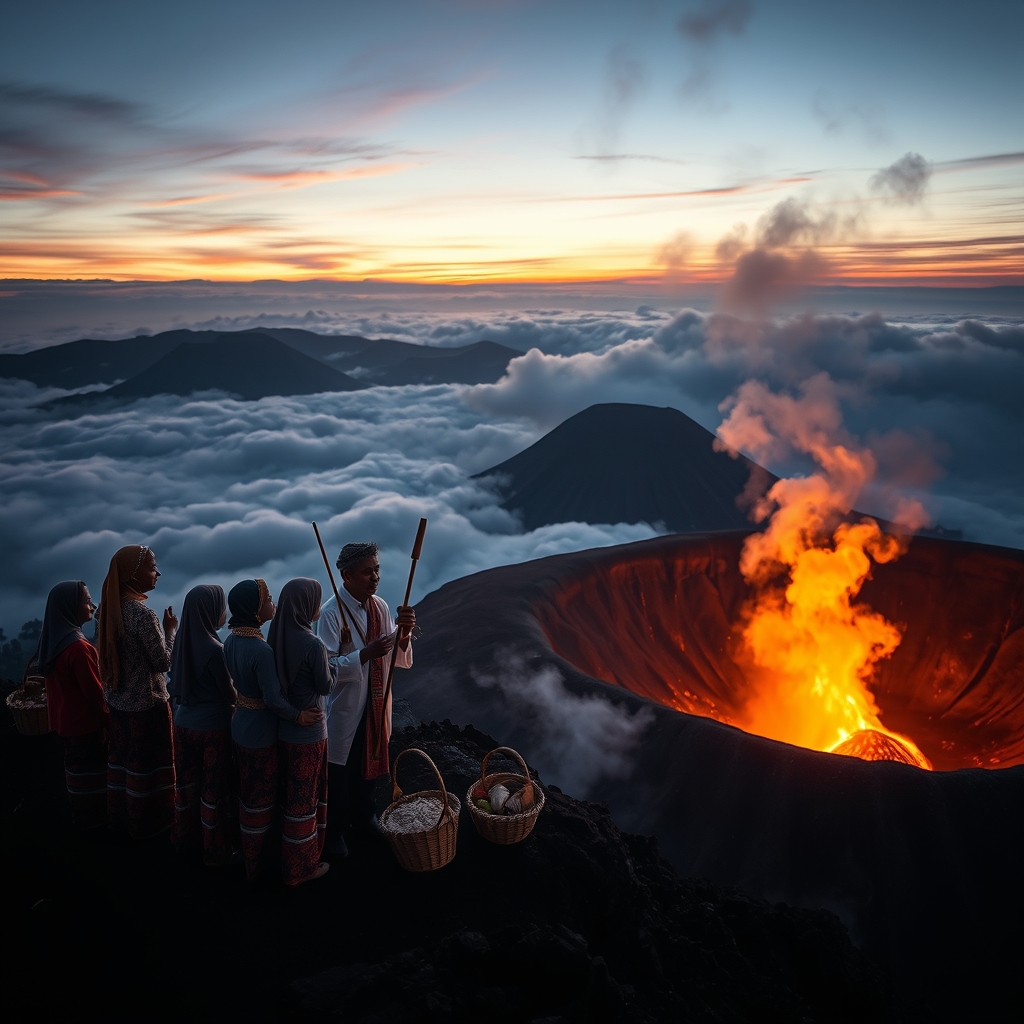
One of the most critical roles of the dukun is to oversee the Yadnya Kasada Festival, a ritual that epitomizes the Tenggerese’s relationship with Mount Bromo. During this festival, the dukun lead processions to the edge of the volcano, where offerings of rice, fruits, vegetables, livestock, and even money are thrown into the crater. These offerings are not merely symbolic; they are acts of devotion, a way to honor the gods and seek their blessings for prosperity and protection.
The Yadnya Kasada Festival: A Spectacle of Faith and Tradition
The Yadnya Kasada Festival is the most iconic event in the Tenggerese calendar, drawing thousands of visitors each year to witness its grandeur. Held on the 14th day of the Kasada month in the traditional Tenggerese calendar—typically falling in June or July—the festival is a vibrant display of culture, faith, and community. The preparations begin weeks in advance, with families gathering offerings and pilgrims traveling from distant villages to participate in the rituals.
The festival reaches its climax at midnight, when the Tenggerese gather at the Luhur Poten Temple to begin their procession. Led by the dukun, they ascend the slopes of Mount Bromo, carrying offerings in baskets and trays. As they reach the edge of the crater, they pause to pray, their voices rising in unison as they invoke the blessings of the gods. Then, in a breathtaking act of faith, they cast their offerings into the abyss below. The sight of fruits, vegetables, and livestock tumbling into the volcano is both mesmerizing and humbling, a testament to the Tenggerese’s unwavering devotion.
The origins of the Yadnya Kasada Festival are rooted in the legend of Roro Anteng and Joko Seger. According to the myth, the couple’s youngest son, Raden Kusuma, was sacrificed to the volcano to ensure the survival of their descendants. The festival is a reenactment of this sacrifice, a way for the Tenggerese to honor their ancestors and renew their covenant with the gods. For outsiders, the festival is a spectacle of color and culture; for the Tenggerese, it is a sacred duty, a moment of connection with their past and their spiritual heritage.
The Modern Challenges to an Ancient Tradition
While the Yadnya Kasada Festival remains a cornerstone of Tenggerese identity, the community faces challenges in preserving their traditions in the face of modernization and tourism. The influx of visitors to Mount Bromo has brought economic opportunities but also pressures to commercialize their culture. Some Tenggerese have embraced tourism, offering guided treks, homestays, and cultural performances, while others worry about the erosion of their sacred rituals and the dilution of their spiritual practices.
Environmental concerns also loom large. Mount Bromo is part of the Bromo Tengger Semeru National Park, a protected area that attracts thousands of tourists each year. The delicate ecosystem of the highlands is vulnerable to the impacts of tourism, from littering to soil erosion. The Tenggerese, who have lived in harmony with the land for centuries, are increasingly vocal about the need to balance conservation with cultural preservation. Efforts are underway to promote sustainable tourism, ensuring that the sacred mountain and its traditions endure for future generations.
The Tenggerese people stand as a living testament to the power of tradition in an ever-changing world. Their story is one of resilience, a community that has weathered the rise and fall of empires, the forces of nature, and the pressures of modernity to preserve a way of life that is uniquely their own. The sacred flames of Mount Bromo continue to burn, a beacon of faith that illuminates the path of the Tenggerese as they navigate the challenges of the present while honoring the legacy of their ancestors. In the heart of the highlands, where the earth meets the sky, the spirit of the Tenggerese endures, a reminder of the enduring bond between humanity and the sacred.