Threads of Time: The Tenggerese Weave of Myth, Mountain, and Memory at Mount Bromo
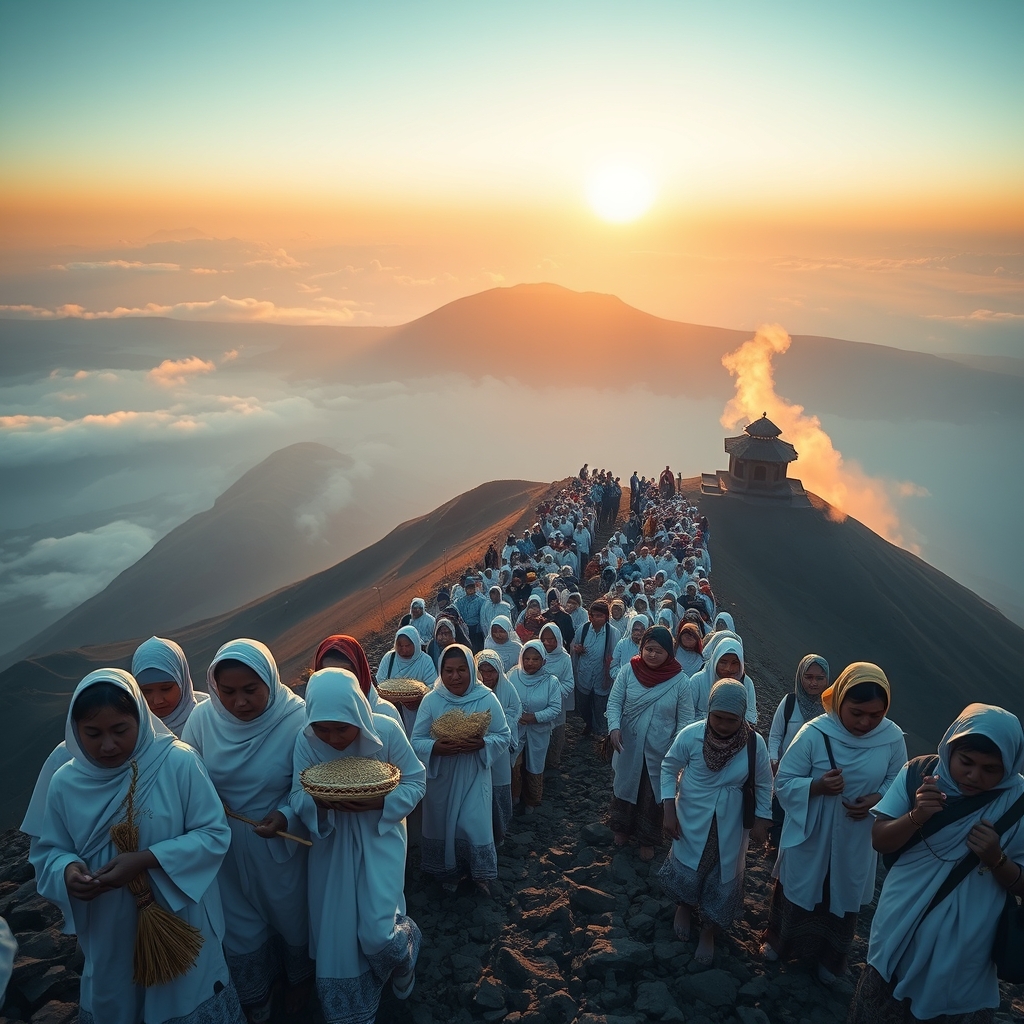
The highlands of East Java cradle a culture as enduring as the volcanic soil beneath its feet. Here, where the mist curls around the jagged peaks of Mount Bromo, the Tenggerese people have woven a tapestry of belief, resilience, and tradition that stretches back centuries. Their story is not merely one of survival, but of a profound symbiosis with the land—a bond forged in the fires of myth and tempered by the relentless passage of time.
The Origins: A Love Story Etched in Stone
At the heart of Tenggerese identity lies the legend of Roro Anteng and Joko Seger, a tale as dramatic as the landscape that inspired it. According to folklore, Roro Anteng, the beautiful daughter of a powerful king, and Joko Seger, a humble but noble youth, fled the wrath of a tyrannical ruler to seek refuge in the untamed wilderness of the Tengger highlands. Their love was tested by the gods, who demanded a sacrifice: the life of their 25th child in exchange for the right to settle and thrive in the shadow of Mount Bromo. With heavy hearts, the couple fulfilled their vow, casting their youngest into the volcano’s crater. From that moment, the Tenggerese people were born, their lineage forever tied to the sacred mountain.
This myth is more than a story; it is the foundation of Tenggerese identity. It explains their origins, their connection to the land, and their unwavering devotion to the rituals that sustain their bond with the divine. The legend of Roro Anteng and Joko Seger is not merely remembered—it is lived, through the ceremonies, offerings, and traditions that have been passed down through generations.
The Sacred Ground: Luhur Poten and the Pulse of Tenggerese Faith
Nestled at the foot of Mount Bromo, the Luhur Poten Temple stands as a testament to the spiritual depth of the Tenggerese people. Unlike the towering Hindu temples of Bali or Java, Luhur Poten is a modest yet sacred structure, its simplicity reflecting the humility and reverence of its worshippers. Built from volcanic stone, the temple is a place where the earthly and the divine intersect, where the Tenggerese gather to honor their ancestors, the mountain, and the gods who watch over them.
The temple is not just a physical space but a living entity, its rituals breathing life into the Tenggerese faith. Here, the dukun, or traditional priests, serve as intermediaries between the people and the spiritual realm. Clad in white robes, their voices rising and falling in ancient chants, the dukun perform ceremonies that have remained unchanged for centuries. These rituals—whether to seek blessings, ward off misfortune, or honor the harvest—are a bridge between the past and the present, a reminder that the Tenggerese are not merely inhabitants of the land but its guardians.
The Yadnya Kasada: A Night of Fire and Faith
If there is one event that encapsulates the essence of Tenggerese culture, it is the Yadnya Kasada Festival. Held annually on the 14th day of the Kasada month in the Tenggerese calendar, this ritual is a breathtaking spectacle of devotion and sacrifice. As the full moon rises over Mount Bromo, thousands of Tenggerese pilgrims ascend the volcano’s slopes, carrying offerings of rice, vegetables, livestock, and even money to cast into the crater. The offerings are not merely gifts but acts of gratitude and supplication, a way to honor the gods and seek their continued protection.
The origins of the Yadnya Kasada are rooted in the legend of Roro Anteng and Joko Seger. It is said that the festival began as a way to fulfill the promise made to the gods—to offer their youngest child in exchange for the right to live in the highlands. Today, the ritual serves as a reminder of the sacrifices that have shaped the Tenggerese people, a moment when the community comes together to reaffirm their bond with the mountain and each other.
The festival is not without its dangers. The trek to the crater is treacherous, the path littered with loose volcanic rock and steep drops. Yet, the Tenggerese undertake this journey with a sense of purpose, their faith unwavering even in the face of the volcano’s unpredictable nature. For them, the Yadnya Kasada is not just a ritual—it is a testament to their resilience, a celebration of their identity, and a reaffirmation of their place in the world.
The Living Legacy: Culture in the Modern Age
In an era of rapid change, the Tenggerese people have managed to preserve their cultural heritage with remarkable tenacity. While modernity has brought new challenges—tourism, environmental pressures, and the encroachment of outside influences—their traditions remain a vital part of their daily lives. The Tenggerese language, a dialect of Javanese, is still spoken in the highlands, and their unique blend of Hinduism, animism, and ancestral worship continues to shape their worldview.
Cultural tourism has played a dual role in this preservation. On one hand, it has brought much-needed economic opportunities to the region, allowing the Tenggerese to share their heritage with the world. On the other, it has forced them to navigate the delicate balance between tradition and commercialization. Yet, even as visitors flock to Mount Bromo to witness the Yadnya Kasada or explore the Luhur Poten Temple, the Tenggerese have remained steadfast in their commitment to their rituals and beliefs. Their culture is not a relic to be displayed but a living, breathing force that adapts without losing its essence.
The history of Mount Bromo is written in fire and ash, its eruptions a reminder of the raw power that lies beneath the earth’s surface. For the Tenggerese, these eruptions are not merely natural disasters but sacred events, moments when the mountain speaks. Each eruption is met with rituals of appeasement, offerings to calm the restless spirits, and a deep sense of humility before the forces of nature. The volcano is not just a geological wonder—it is a deity, a provider, and a protector, its presence woven into the very fabric of Tenggerese life.
The story of the Tenggerese is one of endurance, of a people who have carved out a life in one of the most inhospitable yet beautiful landscapes on earth. Their traditions are not static; they evolve, adapt, and endure, much like the volcanic soil that sustains them. To witness the Yadnya Kasada or stand in the shadow of Luhur Poten is to glimpse a world where myth and reality intertwine, where the past is not forgotten but lived anew with each passing generation. In the highlands of Mount Bromo, the threads of time are woven into a tapestry that is as vibrant and enduring as the culture it represents.