Echoes of the Sacred: The Tenggerese People and Their Enduring Bond with Mount Bromo
The mist-shrouded peaks of Mount Bromo rise like ancient sentinels over the Tengger Highlands, a landscape steeped in myth, history, and spiritual reverence. For the Tenggerese people, this active volcano is not merely a geological wonder but a sacred entity—a living testament to their ancestors, their faith, and their unbreakable connection to the land. Their story is one of resilience, devotion, and a culture that has thrived against the odds, preserving traditions that date back centuries.
The Origins of the Tenggerese: A Legacy Forged in Myth
The origins of the Tenggerese people are woven into the fabric of Javanese folklore, particularly the legendary tale of Roro Anteng and Joko Seger. According to myth, Roro Anteng, the daughter of the Majapahit king Brawijaya, and Joko Seger, a commoner of divine descent, fled the crumbling Majapahit Empire in the 15th century. Seeking refuge in the isolated highlands of East Java, they established a new community and were blessed with 25 children. Yet, their prosperity came with a tragic condition: to appease the gods and ensure the fertility of their land, they were required to sacrifice their youngest child, Kesuma, to the crater of Mount Bromo.
This harrowing legend is more than a cautionary tale; it is the foundation of the Tenggerese identity. The name “Tengger” itself is derived from the last syllables of Roro Anteng and Joko Seger, a linguistic homage to their mythical progenitors. The story also explains the origins of the Yadnya Kasada Festival, an annual ritual where the Tenggerese honor their ancestors by casting offerings into the volcano’s fiery depths.
The Spiritual Heart of the Tenggerese: Luhur Poten and the Dukun
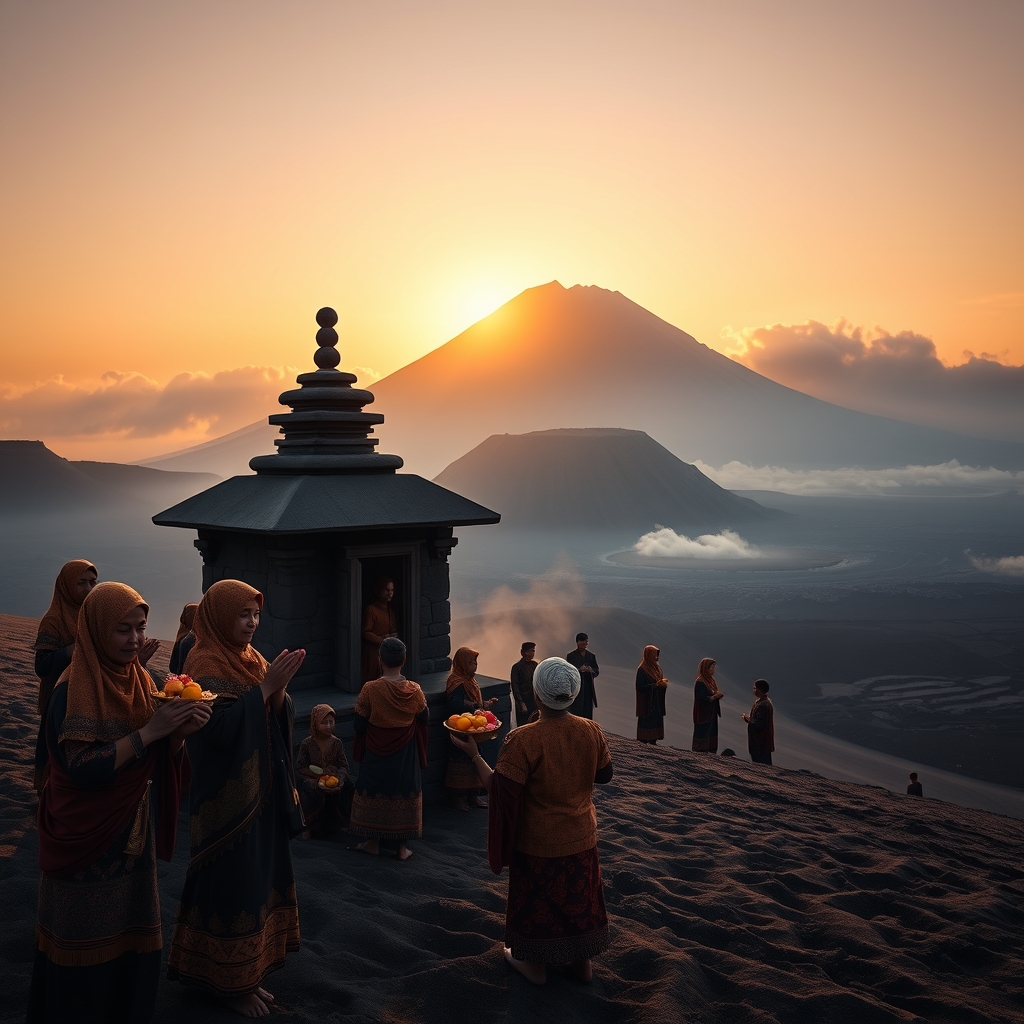
At the heart of Tenggerese spirituality lies Luhur Poten, a sacred temple nestled within the Sea of Sand that surrounds Mount Bromo. Unlike conventional Hindu temples, Luhur Poten is constructed from natural materials—black volcanic stones and sand—reflecting the Tenggerese belief in harmony with nature. The temple serves as the epicenter of their religious life, where ceremonies are conducted to seek blessings, protection, and guidance from the gods.
Central to these rituals are the dukun, or Tenggerese priests, who act as intermediaries between the community and the divine. The dukun undergo rigorous training, mastering ancient chants, herbal remedies, and the intricate symbolism of offerings. Their role is not merely spiritual but also medicinal, as they often serve as healers, using traditional knowledge passed down through generations. The dukun’s authority is deeply respected, and their presence is indispensable during major ceremonies, including the Yadnya Kasada Festival.
The Yadnya Kasada Festival: A Testament to Faith and Sacrifice
Held on the 14th day of the Kasada month in the Tenggerese calendar—typically falling in June or July—the Yadnya Kasada Festival is the most significant event in Tenggerese culture. The festival is a vibrant, multi-day affair that begins with processions to Luhur Poten, where prayers and offerings are made to Sang Hyang Widhi, the supreme god in Tenggerese Hinduism. The climax occurs at midnight, when thousands of Tenggerese ascend the steep slopes of Mount Bromo to cast their offerings—fruits, vegetables, livestock, and even money—into the volcano’s crater.
The act of throwing offerings into the abyss is a reenactment of the sacrifice of Kesuma, a symbolic gesture of gratitude and supplication. It is believed that the gods will bless the community with fertility, prosperity, and protection in return. For outsiders, the festival is a mesmerizing spectacle of devotion, but for the Tenggerese, it is a sacred duty, a renewal of their covenant with the divine.
The Tenggerese Way of Life: Harmony with Nature and Tradition
The Tenggerese people have long lived in harmony with the volatile landscape of the Bromo-Tengger-Semeru National Park. Their agricultural practices, such as terrace farming and crop rotation, are adapted to the highland environment, ensuring sustainability in a region prone to eruptions. The fertile soil, enriched by volcanic ash, yields crops like potatoes, cabbage, and onions, which form the backbone of their economy.
Beyond agriculture, the Tenggerese are known for their distinctive cultural practices. Their language, a dialect of Javanese, retains archaic elements that have faded from modern usage. Traditional attire, such as the kain tenun (woven cloth) and udeng (headcloth), is worn during ceremonies, preserving a visual link to their heritage. Music and dance, particularly the tari topeng (mask dance), are integral to their cultural expression, often performed during festivals and rituals.
Mount Bromo: A Living Chronicle of Eruptions and Resilience
Mount Bromo’s history is as dramatic as the legends that surround it. The volcano has erupted over 50 times since the 18th century, with the most devastating eruption in 2010 displacing thousands of Tenggerese and blanketing the region in ash. Yet, each time, the community has returned, rebuilding their lives with an unshakable resolve. For the Tenggerese, Bromo’s eruptions are not merely natural disasters but divine messages—a reminder of the gods’ power and the need for humility.
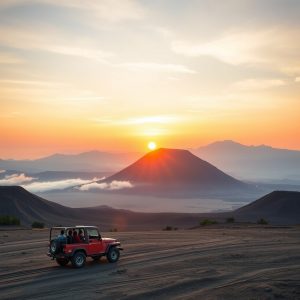
The volcano’s eruptions have also shaped the landscape, creating the otherworldly Sea of Sand and the towering cliffs of the Tengger Caldera. These natural wonders attract thousands of tourists annually, drawn by the allure of Bromo’s sunrise views and the mystique of its cultural heritage. While tourism has brought economic opportunities, it has also posed challenges, as the Tenggerese strive to balance modernization with the preservation of their traditions.
Preserving a Cultural Legacy in a Changing World
In an era of globalization, the Tenggerese face the dual pressures of cultural erosion and environmental change. Younger generations, exposed to urban lifestyles, are increasingly moving away from the highlands, threatening the continuity of traditions. Yet, the Tenggerese have shown remarkable adaptability, integrating tourism into their economy while safeguarding their rituals and beliefs. Initiatives such as cultural education programs and eco-tourism projects aim to ensure that their heritage endures for future generations.
The story of the Tenggerese is a testament to the power of faith, community, and resilience. Their bond with Mount Bromo transcends time, a living legacy of myth, history, and spirituality. As the sun rises over the Tengger Highlands, casting golden light on the Sea of Sand, it illuminates not just a landscape but a people who have turned adversity into reverence, and tradition into eternity. In their rituals, their stories, and their unwavering devotion, the Tenggerese remind us that some connections are too sacred to sever, too profound to fade.